
This document describes the principal operational hazards associated with Arenal Rafting activities and the preventive, operational and emergency controls used to reduce exposure to those hazards. It covers guide competency, participant preparation, river monitoring, descent organization, rescue resources, equipment, maintenance, communications, ground monitoring and emergency evacuation.
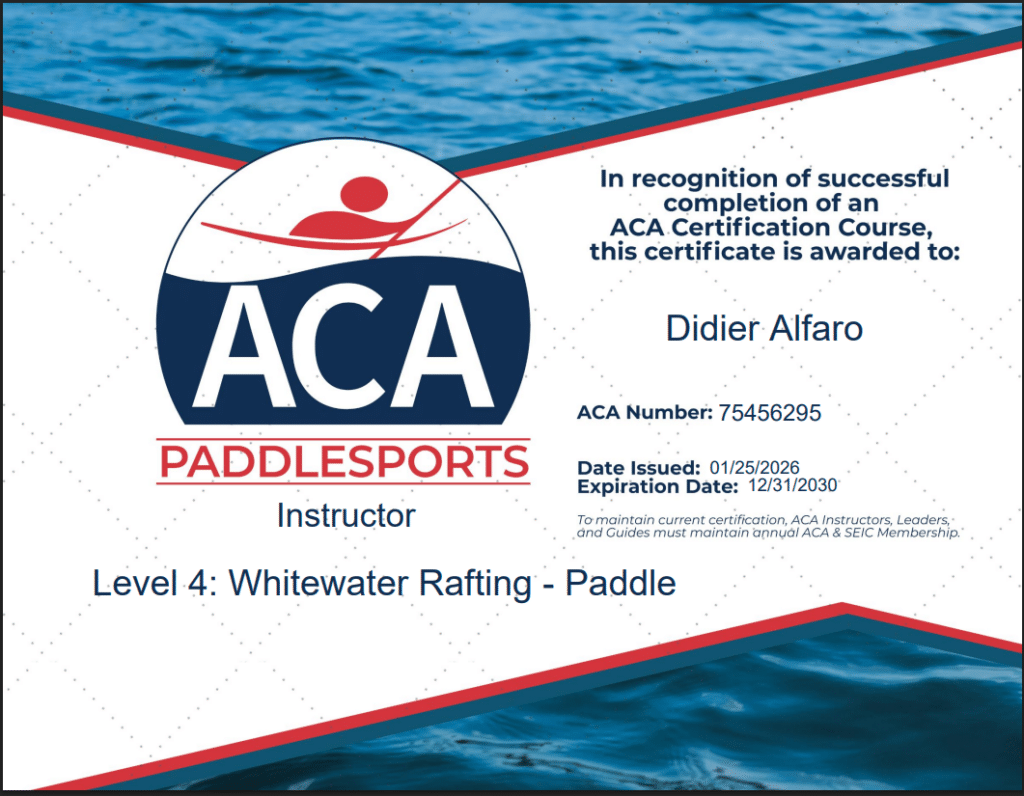
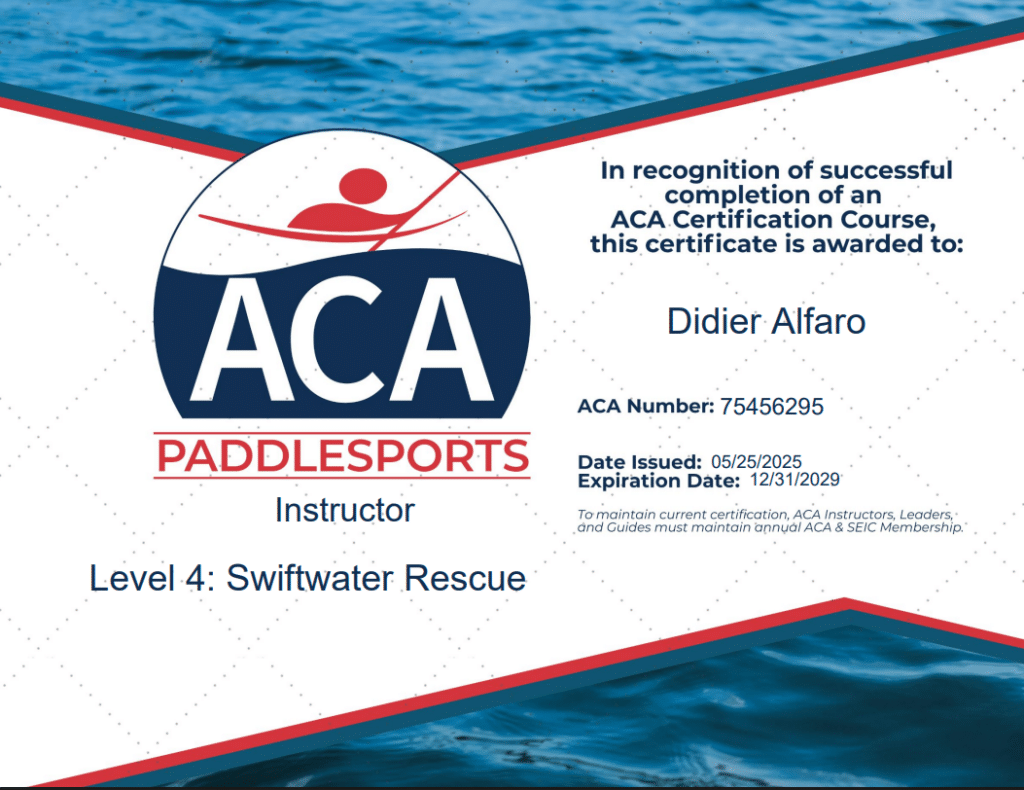
Arenal Rafting employs an in-house Guide Instructor and Risk Management & Mitigation Lead, Didier Alfaro, a rafting guide with 18 years of professional experience and a guide instructor certified through the American Canoe Association (ACA / ACA Paddle Sports). His responsibilities include training and updating company guides in swiftwater rescue, whitewater guiding, incident prevention, safety procedures and emergency response.
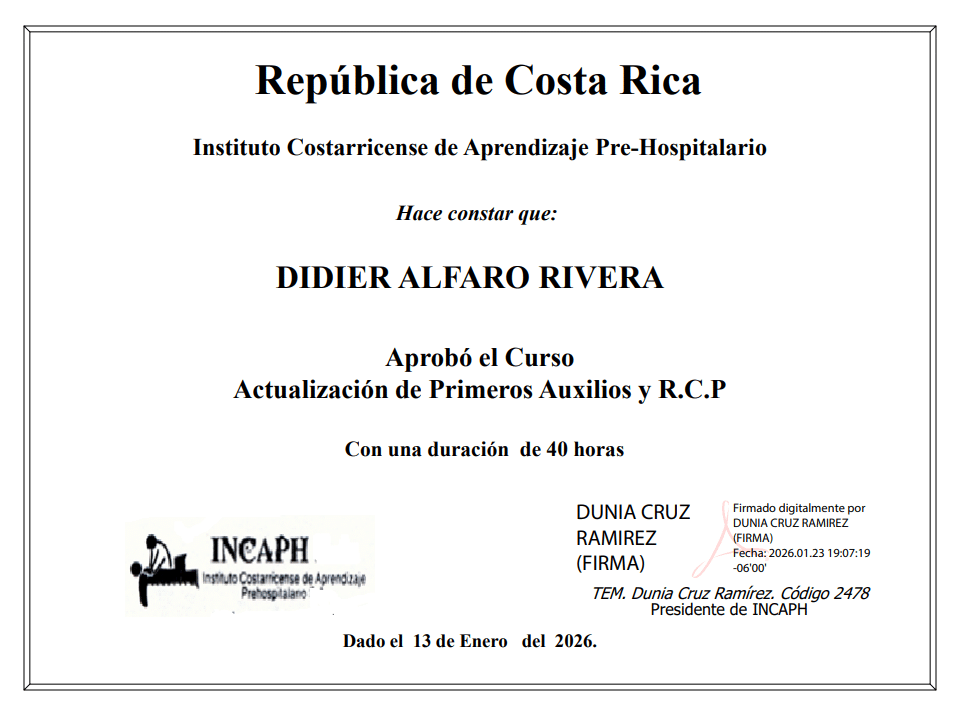
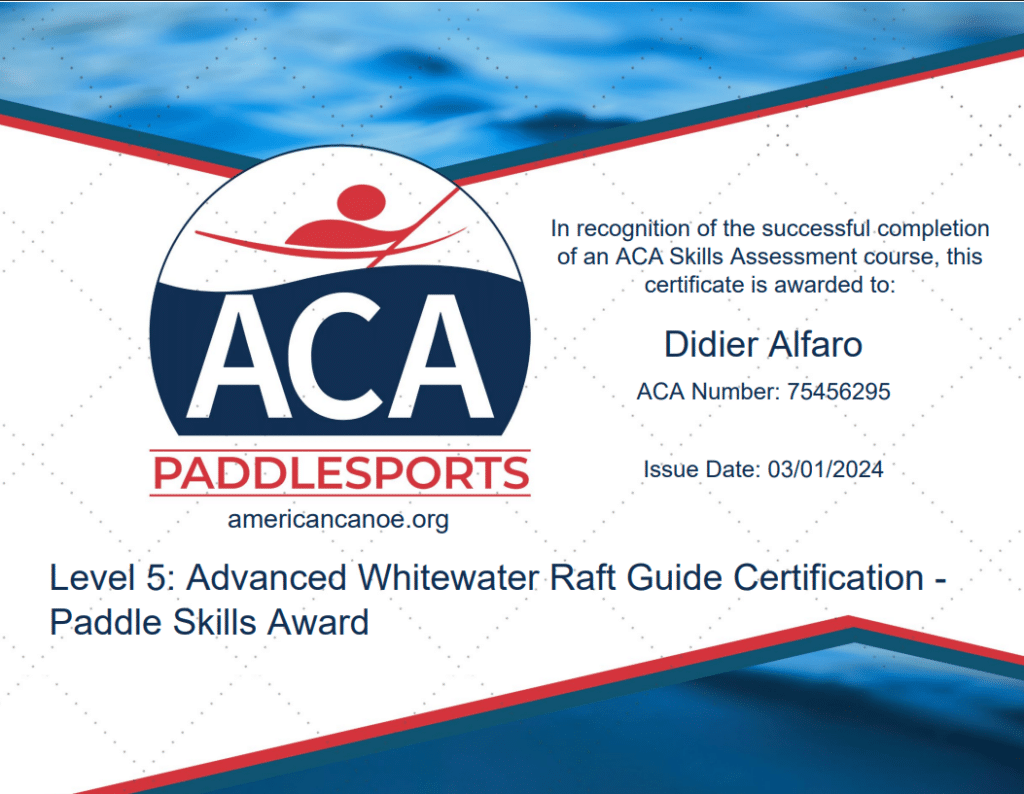
The qualifications of Arenal Rafting’s in-house Guide Instructor and Risk Management & Mitigation Lead are supported by the following professional credentials:
Copies of these credentials should be retained with the audit package as supporting evidence for guide competency, internal training capability and risk-management oversight.
The American Canoe Association, founded in the United States in 1880, is used by Arenal Rafting as a technical reference for paddlesports safety and instruction. ACA safety principles and training standards are incorporated into internal guide development and operational procedures.
All operational guides are required to maintain current First Aid and Cardiopulmonary Resuscitation (CPR) certification. These certifications must be renewed every two years. This requirement complements each guide’s individual first-aid equipment and distributes initial medical-response capability throughout the rafting formation.
arenal rafting guide’s certifications – Swiftwater-Rescue-Certification
arenal rafting guides certifications – Whitewater-Rafting-Paddle-Certification


Arenal Rafting operates primarily on the Balsa and Sarapiquí rivers. Both systems are influenced by hydroelectric operations, and flow in the tour sections can vary according to generation conditions. Each morning, Operations obtains updated information regarding river level and conditions. When relevant anomalies occur because of natural conditions or hydroelectric operations, updated information can be communicated to Operations.
The Head Guide combines this information with weather observations and direct field assessment to determine passenger loading per raft, raft order, regrouping/eddy stops, safety-kayak support and other operational adjustments.
The Head Guide determines the order of rafts according to river level, weather, participant composition, paddling capability and available river information. Stronger paddling teams may be positioned toward the front, while families, children and groups requiring a more conservative approach may be positioned farther back. The most experienced guides are preferentially positioned in the first and last rafts.
As an operational baseline, one safety kayaker is assigned per ten rafts, with additional support when conditions require it. Safety kayakers can inspect rapids ahead of the rafting formation. If the normal navigation line has changed, the information is relayed to following rafts through standardized whitewater signals.
Rafts maintain an appropriate operational distance while preserving visual contact, whenever river geometry permits, between the raft downstream and the raft immediately upstream. This creates a visual communication chain through which signals can be relayed from the first raft to the last raft.
One of the principal risk-reduction controls is the safety briefing provided before participants enter the river. The briefing begins during transportation to the river and is reinforced as necessary before launching. Participants are instructed on raft anatomy, paddler position, foot support, correct paddle grip, paddling commands and efficient body mechanics, including the “Paddle in the Box” concept.
Safety commands and positions include Get Down, Lean In and High Side. These are used to lower the center of gravity, reduce exposure to objects near the raft and use participant body weight to help stabilize a raft when necessary.
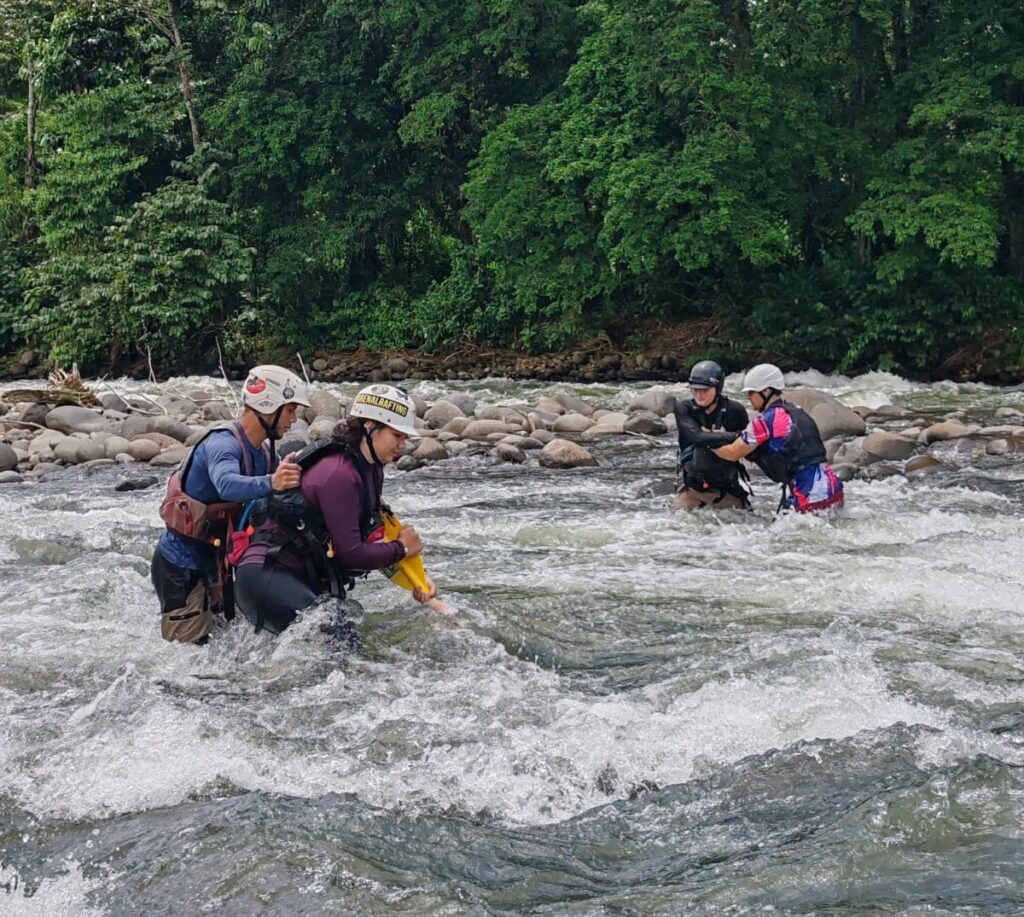
Participants receive detailed instruction on defensive swimming in whitewater, offensive/aggressive swimming when active movement toward safety is required, and self-rescue. Particular emphasis is placed on keeping the feet elevated in defensive swimming and avoiding attempts to stand in moving current where foot entrapment may occur.
The briefing also covers safe assistance by other paddlers, throw-rope use, the role of safety kayakers and response to swimmers. Flip situations are addressed through a dedicated procedure/annex.
At the river, participants are asked about relevant medical conditions, physical limitations, previous experience and expectations. This information is considered together with family and group composition when allocating participants among rafts.
Relevant information is transferred from the guide responsible for the transport/briefing and group organization to the guide responsible for each raft. The raft guide then uses this information and direct observation to position paddlers appropriately, seeking a balanced configuration that supports stability, maneuverability and an experience adapted to the characteristics of the participants.
When one or more participants enter the water, whistles are used as an immediate alert to downstream rafts and safety personnel. This allows downstream resources to identify the swimmer and prepare for rescue. The operational objective is to minimize, as safely as possible, the time a participant remains separated from a raft, using the rescue resource best positioned for the circumstances.
Arenal Rafting treats strainers—fallen trees, branches, logs or other objects that allow water to pass while potentially trapping a person—as high-severity hazards. Rapids or sections affected by these hazards are not run without prior inspection by safety personnel.
Where an obstruction cannot be managed with an acceptably safe navigation line, exposure is avoided. When access and terrain permit, the rapid is bypassed by portage along the riverbank. If conditions change, the Head Guide reassesses the descent strategy before subsequent rafts enter the affected section. Continuation of the itinerary does not take priority over avoiding unnecessary exposure to an entrapment hazard.
As a condition of working in river operations, each guide must carry personal equipment suitable for whitewater guiding and emergency response. Required equipment includes:
This equipment supports swimmer rescue, communication, first aid and mechanical-advantage rescue systems without relying exclusively on equipment carried by another raft.
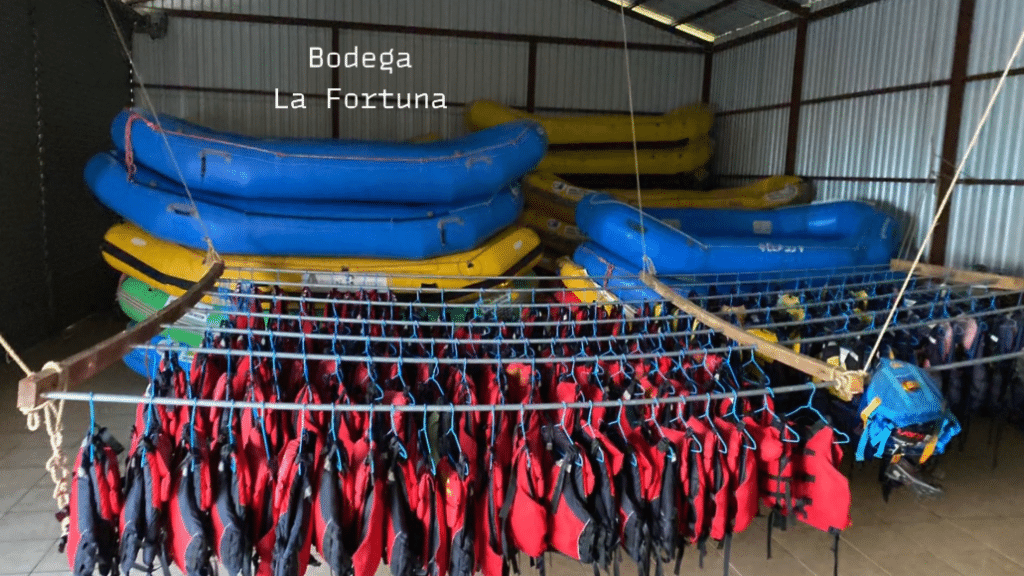
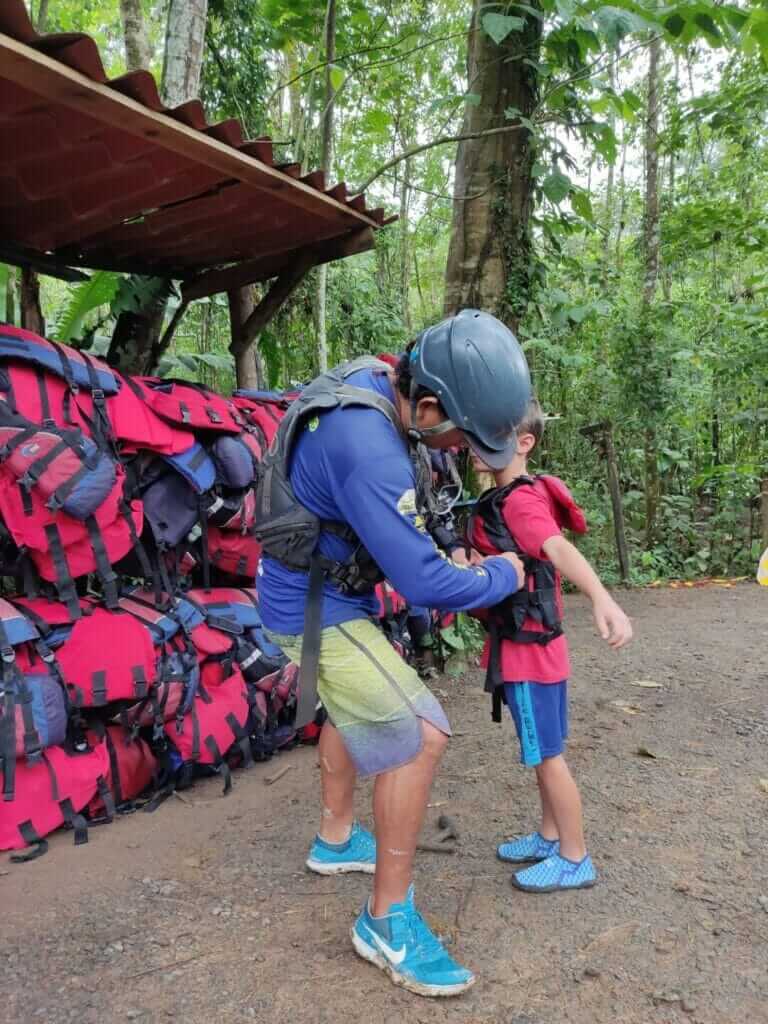
Each participant is provided with personal safety equipment before entering the river. The equipment is fitted before launch and remains in use during the activity. It includes a Type V PFD, an adjustable universal-size whitewater helmet and a rafting paddle with T-grip.
Arenal Rafting maintains 250 Type V PFDs acquired in June 2025: 220 units providing approximately 25 lb of flotation and 30 units providing up to approximately 30 lb of flotation. The PFDs were designed and manufactured in Colombia by Ofterra specifically for Arenal Rafting. Customized features include fit-related details and buckles selected/reinforced according to specifications requested by Arenal Rafting. The participant PFD design also incorporates head-flotation support.
Equipment | Quantity | Flotation | Manufacturer | Acquired |
Type V PFD | 220 | ≈25 lb | Ofterra, Colombia | June 2025 |
Type V PFD | 30 | Up to ≈30 lb | Ofterra, Colombia | June 2025 |
Total | 250 | — | Ofterra | June 2025 |
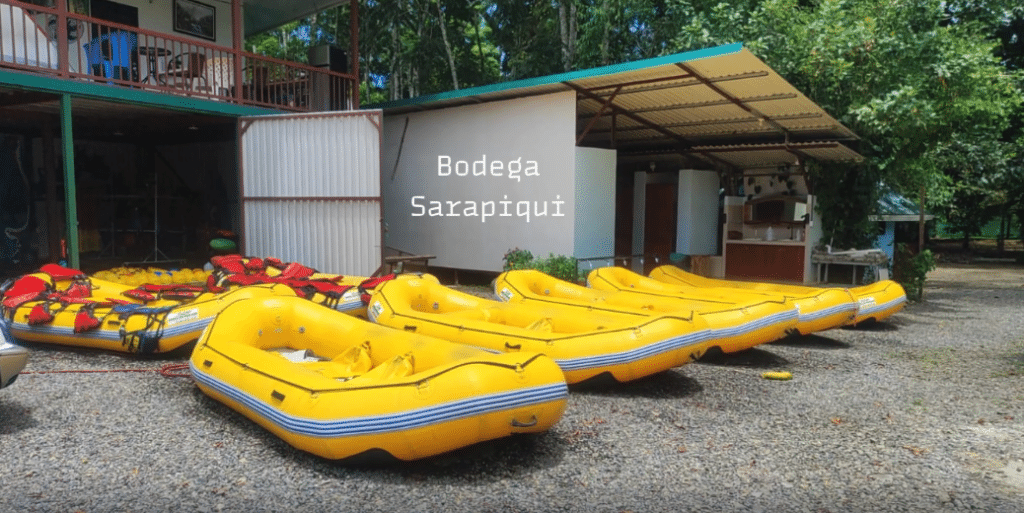
Arenal Rafting maintains a fleet of more than 40 rafts with capacity for six participants plus one guide, acquired in January 2025. The rafts were manufactured in China by the company’s supplier under customized specifications developed from Arenal Rafting’s operational experience with equipment from brands such as SOTAR, AIRE and NRS.
The custom configuration includes reinforced floors, reinforced/strategically positioned D-rings, foot cups at paddler positions, and a self-bailing system with an additional protective layer on the underside intended to protect the drainage area from contact with rocks, branches or pointed objects.
The rafts have a planned operational life of up to eight years, subject to condition, inspection, maintenance and retirement criteria. The planned service life does not replace inspection or guarantee that a raft remains in service for the full period.
Rafts are inspected daily and inflation is configured for the conditions of the river and the assigned load. In lower water, pressure may be reduced in a controlled manner to provide greater flexibility when contacting rocks. In higher water, a firmer configuration may be used to improve structural response through waves. The raft guide may also adjust inflation according to the number, approximate weight and distribution of participants.

Arenal Rafting also has personnel trained to perform equipment maintenance and repairs. Equipment showing damage, abnormal wear, loss of functionality or another condition that could compromise safe performance can be removed from operation for evaluation, maintenance or repair before return to service.
The control cycle is: appropriate storage → daily inspection → identification of damage/wear → maintenance or repair → verification of condition → return to service.
Each guide carries an individual first-aid kit and maintains current First Aid/CPR certification. The final raft carries the most complete communication and first-aid resources available for the operation. Experienced guides positioned at the front and rear of the formation provide additional operational redundancy.
Arenal Rafting also has personnel trained to perform equipment maintenance and repairs. Equipment showing damage, abnormal wear, loss of functionality or another condition that could compromise safe performance can be removed from operation for evaluation, maintenance or repair before return to service.
The control cycle is: appropriate storage → daily inspection → identification of damage/wear → maintenance or repair → verification of condition → return to service.
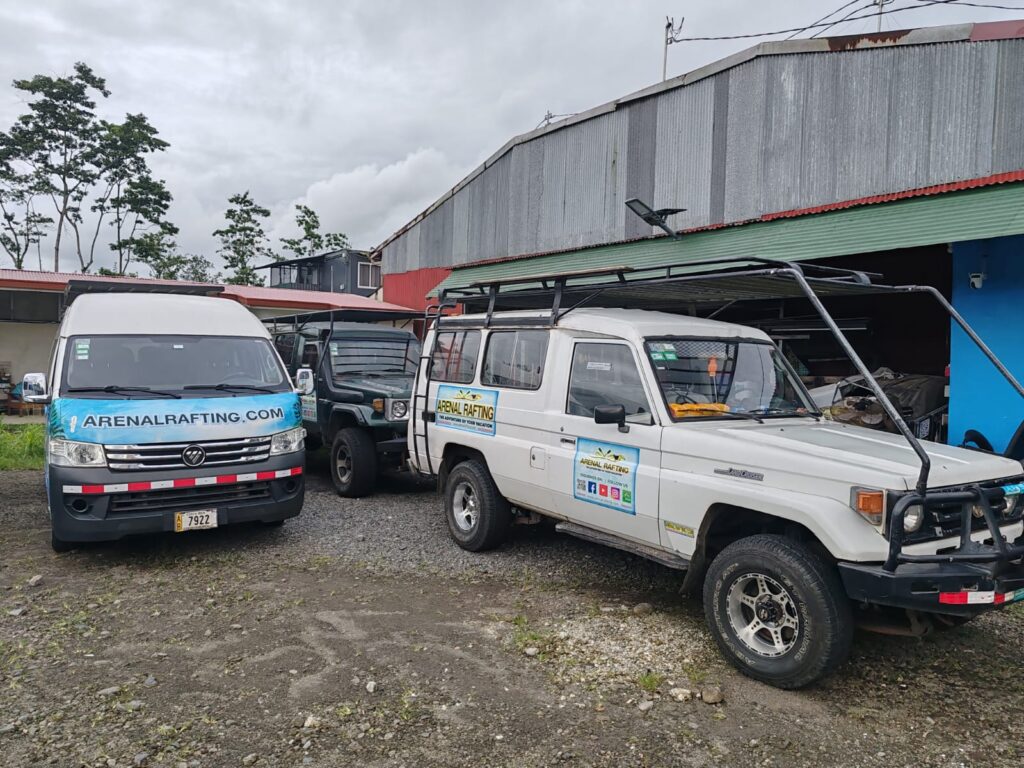
The 4×4 pickup vehicles used to transport rafting equipment also provide ground monitoring during the descent. Drivers stop at selected road-access/checkpoint locations, verify the passage and apparent condition of the rafts, report to the Operations Center after all rafts in the group have passed, and then move downstream to the next monitoring point. Photographic evidence of Arenal Rafting ground-support vehicles is included in Section 20.
The vehicles also observe river level/conditions, remain in communication with the Head Guide and serve as the primary ground transportation resource for emergency evacuation when access conditions permit.
Arenal Rafting maintains evacuation procedures and multiple emergency exit/access points along the river sections used for tours. These points allow a descent to be interrupted when injury, illness, changing river conditions or another emergency requires removal of a participant before the normal take-out.
The Head Guide, raft guides, safety kayakers, 4×4 drivers and Operations Center coordinate the extraction point and required resources. Route-specific evacuation maps and access-point identifiers should be maintained as supporting annexes.
Arenal Rafting’s risk-management framework is complemented by a Civil Liability Umbrella insurance policy issued by the Instituto Nacional de Seguros (INS) of Costa Rica. The supplied policy documentation identifies policy No. 0206RCU000006804, an insured amount of USD 1,000,000, and a policy period from December 4, 2025 through December 4, 2026, with the policy shown as active. Coverage for any particular activity, event or claim remains subject to the complete policy terms, conditions, endorsements and exclusions.
A copy of the current INS policy documentation is retained as supporting evidence. The supplied particular conditions summarize relevant policy information and do not by themselves constitute the complete insurance contract.
Lorem ipsum dolor sit amet, consectetur adipiscing elit. Ut elit tellus, luctus nec.